The site of the new Visitor Centre is a layered story, both physically and historically—a place en route and, perpetually, it seems, in transition.
Above ground it was important to maintain a respectful distance between the Visitor Centre and both the fort and Garrison Common (part of the 1813 battlefield). To the south, the elevated Gardiner Expressway provided its own set of challenges. Below the ground, archaeological excavations were, in 2009, beginning to reveal features of interest to be taken into consideration by the five short-listed architectural teams that were preparing submissions.
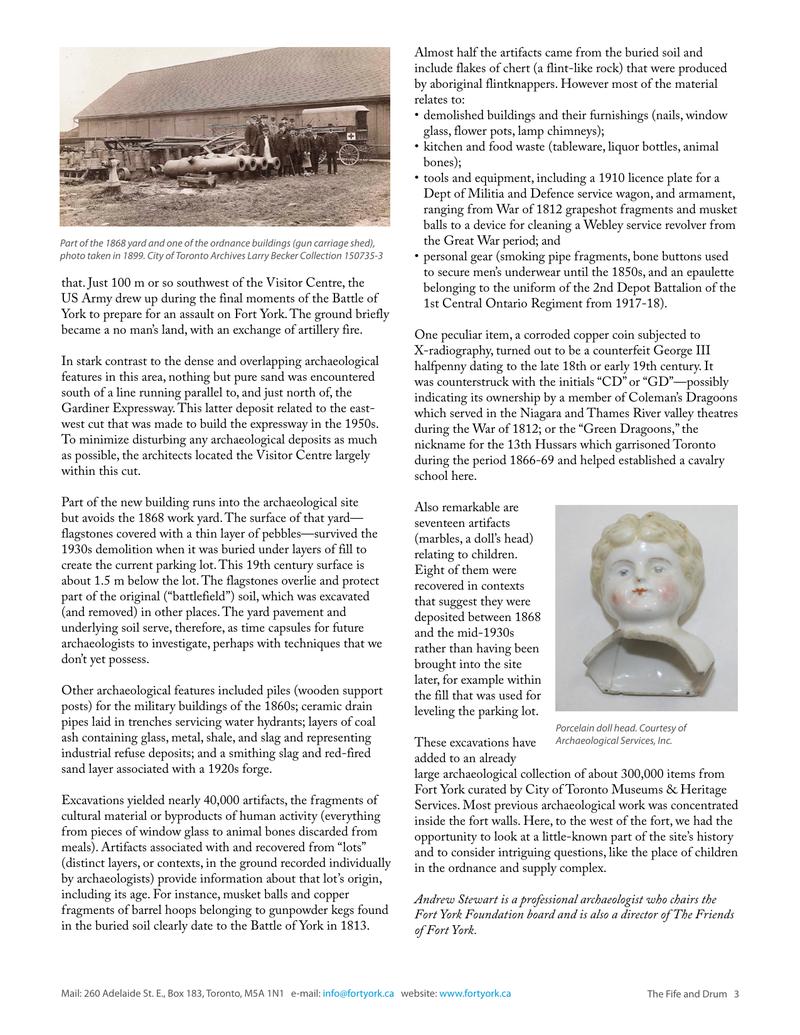
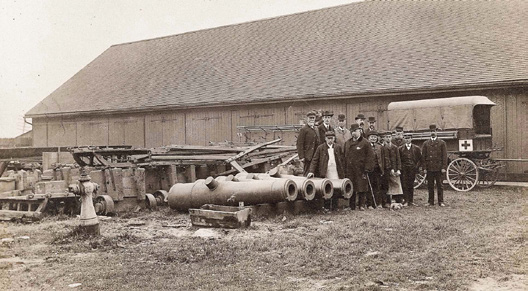
During excavations in 2009-10 by Archaeological Services, Inc. (ASI) and Strata Consulting Inc., followed by more excavations in 2010-11 by ASI, a substantial area south of Garrison Road was found to contain layers of evidence for a complex of ordnance and supply buildings, and a work yard, all enclosed by a high wooden fence. Established in 1868, this complex expanded to the west in the 1910s and was demolished in the mid-1930s.
Under these layers of archaeological evidence, a deeply buried dark soil was preserved. This soil essentially represents the surface of the ground on which the military complex was built. It was also part of Fort York’s field of fire during the War of 1812. The ground had been deliberately cleared of vegetation to deny an enemy cover and allow the fort’s guns to be brought to bear on a force approaching from the west. At approximately 1 pm on 27 April 1813 they did precisely that. Just 100 m or so southwest of the Visitor Centre, the US Army drew up during the final moments of the Battle of York to prepare for an assault on Fort York. The ground briefly became a no man’s land, with an exchange of artillery fire.
In stark contrast to the dense and overlapping archaeological features in this area, nothing but pure sand was encountered south of a line running parallel to, and just north of, the Gardiner Expressway. This latter deposit related to the east-west cut that was made to build the expressway in the 1950s. To minimize disturbing any archaeological deposits as much as possible, the architects located the Visitor Centre largely within this cut.
Part of the new building runs into the archaeological site but avoids the 1868 work yard. The surface of that yard—flagstones covered with a thin layer of pebbles—survived the 1930s demolition when it was buried under layers of fill to create the current parking lot. This 19th century surface is about 1.5 m below the lot. The flagstones overlie and protect part of the original (“battlefield”) soil, which was excavated (and removed) in other places. The yard pavement and underlying soil serve, therefore, as time capsules for future archaeologists to investigate, perhaps with techniques that we don’t yet possess.
Other archaeological features included piles (wooden support posts) for the military buildings of the 1860s; ceramic drain pipes laid in trenches servicing water hydrants; layers of coal ash containing glass, metal, shale, and slag and representing industrial refuse deposits; and a smithing slag and red-fired sand layer associated with a 1920s forge.
Excavations yielded nearly 40,000 artifacts, the fragments of cultural material or byproducts of human activity (everything from pieces of window glass to animal bones discarded from meals). Artifacts associated with and recovered from “lots” (distinct layers, or contexts, in the ground recorded individually by archaeologists) provide information about that lot’s origin, including its age. For instance, musket balls and copper fragments of barrel hoops belonging to gunpowder kegs found in the buried soil clearly date to the Battle of York in 1813.
Almost half the artifacts came from the buried soil and include flakes of chert (a flint-like rock) that were produced by aboriginal flintknappers. However most of the material relates to:
- demolished buildings and their furnishings (nails, window glass, flower pots, lamp chimneys);
- kitchen and food waste (tableware, liquor bottles, animal bones);
- tools and equipment, including a 1910 licence plate for a Dept of Militia and Defence service wagon, and armament, ranging from War of 1812 grapeshot fragments and musket balls to a device for cleaning a Webley service revolver from the Great War period; and
- personal gear (smoking pipe fragments, bone buttons used to secure men’s underwear until the 1850s, and an epaulette belonging to the uniform of the 2nd Depot Battalion of the 1st Central Ontario Regiment from 1917-18).
One peculiar item, a corroded copper coin subjected to X-radiography, turned out to be a counterfeit George III halfpenny dating to the late 18th or early 19th century. It was counterstruck with the initials “CD” or “GD”—possibly indicating its ownership by a member of Coleman’s Dragoons which served in the Niagara and Thames River valley theatres during the War of 1812; or the “Green Dragoons,” the nickname for the 13th Hussars which garrisoned Toronto during the period 1866-69 and helped established a cavalry school here.

Also remarkable are seventeen artifacts (marbles, a doll’s head) relating to children. Eight of them were recovered in contexts that suggest they were deposited between 1868 and the mid-1930s rather than having been brought into the site later, for example within the fill that was used for leveling the parking lot.
These excavations have added to an already large archaeological collection of about 300,000 items from Fort York curated by City of Toronto Museums & Heritage Services. Most previous archaeological work was concentrated inside the fort walls. Here, to the west of the fort, we had the opportunity to look at a little-known part of the site’s history and to consider intriguing questions, like the place of children in the ordnance and supply complex.
Original printed pages