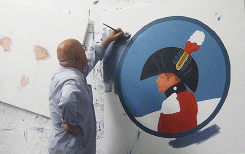
Oct. The Coloured Corps of Black volunteers, formed in August, reached full strength when 14 men joined from the Third York Militia. The unit saw its first action at the Battle of Queenston Heights.
Oct. 10 The Rev. John Strachan, newly arrived in York, advertised that he had opened a school. Common education was £6 per annum; Classical education £8. Rates reduced somewhat for poorer parents provided they kept their children neat and clean, and supplied them with proper books.
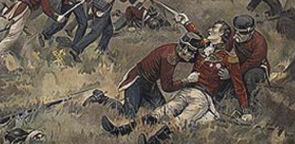
Oct. 13 Sir Isaac Brock was killed at Queenston Heights while repelling an American invasion. To his successor, Roger Hale Sheaffe, fell the credit for securing victory in these tragic circumstances. Sheaffe also succeeded Brock as administrator of Upper Canada.
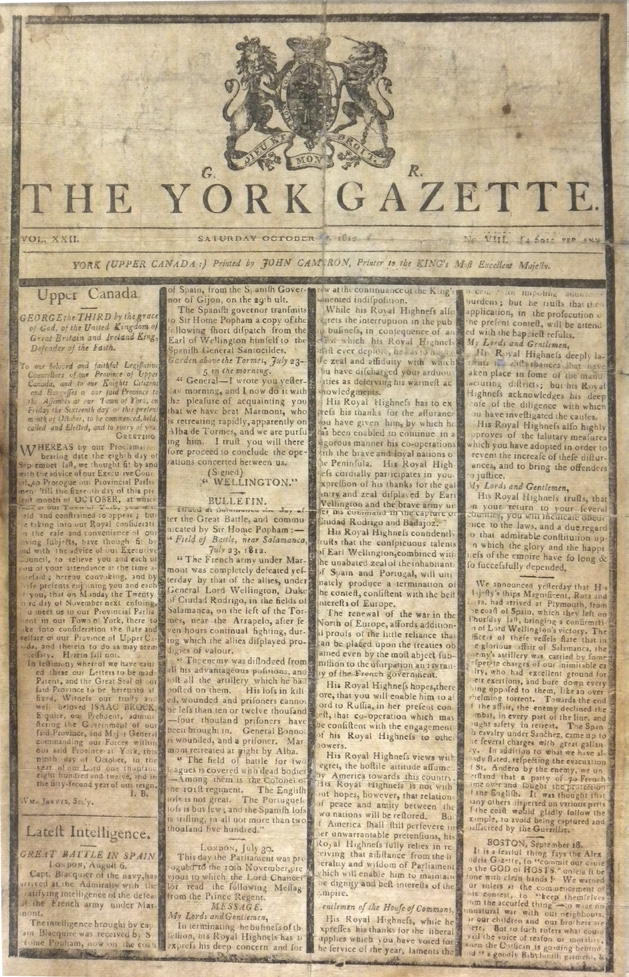
Oct. 24 A plan of the funeral procession for Isaac Brock and his aide-de-camp, Lt. Col. John Macdonell, was published in the York Gazette. Showing the position of their coffins among the troops, Native allies, muffled drums, and mourners, the plan was copied in the Quebec Gazette/Gazette de Québec (29 Oct.), Montreal Gazette/Gazette de Montréal (3 Nov.), and Kingston Gazette (17 Nov.).
Oct. 29, 31 After issuing a supplement (24 Oct.) with news of the victory at Queenston and the death of the “gallant and ever-to-be-lamented Chief, Major Genl. BROCK” the Quebec Gazette published a lengthy editorial which opens: “THE news of the death of this excellent Officer has been received here, as a public calamity. The attendant circumstances of victory scarcely checked the painful sensation. His long residence in this Province, and particularly in this place, had made him, in habits and good offices, almost a citizen, and his frankness, conciliatory disposition, and devoted demeanor an estimable one.”
Nov. The earliest-printed view of York, engraved by William S. Leney, was published by S.F. Bradford of Philadelphia. It shows the Berkeley Street blockhouse with Lake Ontario and the town beyond.
Nov. 1 Dr. John Strachan, Missionary at York, to the Society for the Propagation of the Gospel in Foreign Parts: “…the bustle and confusion occasioned by the war gives him but little opportunity of ascertaining the state of the Parish; most of the people being on the lines resisting invasion… They daily expect an attack from the enemy; but the Province is wonderfully animated, & with a few more troop will have nothing to fear.”
Nov. 12 An American standard taken in the Battle of Queenston was displayed in the Castle Yard at Quebec. According to the Gazette “It had altogether a mean appearance.”
Dec. 12 John Sandfield Macdonald, first premier of Ontario after Confederation, was born at St. Raphael’s, Glengarry County, Upper Canada.
Dec. 15 The Loyal and Patriotic Society of Upper Canada was organized to provide care and modest relief to soldiers, their families, and the poor. Some of its donations were used to found the Toronto General Hospital. The Society also had more than 600 gold and silver medals struck but couldn’t decide who should receive them. Only three escaped being melted down in 1841; they are now on display at Fort York (Fife and Drum March 2011).
Dr. Carl Benn, Chair, Department of History, Ryerson University, Toronto, has written an authoritative essay on the medals that is found on The Friends’ website: http://www.fortyork.ca/index.php/resources/historical-essays
Original printed pages