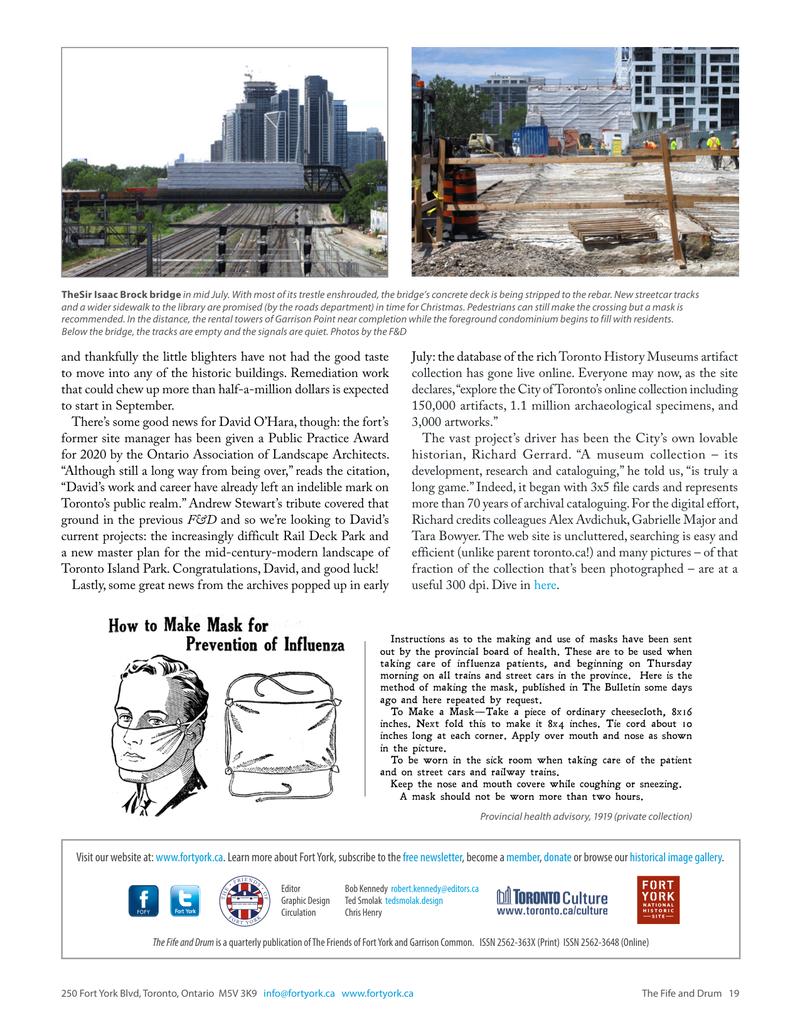
and thankfully the little blighters have not had the good taste to move into any of the historic buildings. Remediation work that could chew up more than half-a-million dollars is expected to start in September.
There’s some good news for David O’Hara, though: the fort’s former site manager has been given a Public Practice Award for 2020 by the Ontario Association of Landscape Architects. “Although still a long way from being over,” reads the citation, “David’s work and career have already left an indelible mark on Toronto’s public realm.” Andrew Stewart’s tribute covered that ground in the previous F&D and so we’re looking to David’s current projects: the increasingly difficult Rail Deck Park and a new master plan for the mid-century-modern landscape of Toronto Island Park. Congratulations, David, and good luck!
Lastly, some great news from the archives popped up in early July: the database of the rich Toronto History Museums artifact collection has gone live online. Everyone may now, as the site declares, “explore the City of Toronto’s online collection including 150,000 artifacts, 1.1 million archaeological specimens, and 3,000 artworks.”
The vast project’s driver has been the City’s own lovable historian, Richard Gerrard. “A museum collection – its development, research and cataloguing,” he told us, “is truly a long game.” Indeed, it began with 3×5 file cards and represents more than 70 years of archival cataloguing. For the digital effort, Richard credits colleagues Alex Avdichuk, Gabrielle Major and Tara Bowyer. The web site is uncluttered, searching is easy and efficient (unlike parent toronto.ca!) and many pictures – of that fraction of the collection that’s been photographed – are at a useful 300 dpi. Dive in here.
How to Make Mask for Prevention of Influenza
Instructions as to the making and use of masks have been sent out by the provincial board of health. These are to be used when taking care of influenza patients, and beginning on Thursday morning on all trains and street cars in the province. Here is the method of making the mask, published in The Bulletin some days ago and here repeated by request.
To Make a Mask —Take a piece of ordinary cheesecloth, 8×16 inches. Next fold this to make it 8×4 inches. Tie cord about 10 inches long at each corner. Apply over mouth and nose as shown in the picture.
To be worn in the sick room when taking care of the patient and on street cars and railway trains.
Keep the nose and mouth covered while coughing or sneezing. A mask should not be worn more than two hours.
Provincial health advisory, 1919 (private collection)
Original printed pages