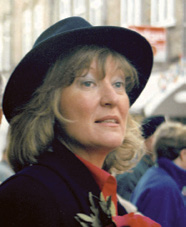
The Friends of Fort York lost a great supporter and friend on July 21 when Robert Malcomson of St. Catharines, aged 60, from a brain tumor that beset him for the last 17 months. Canada’s dean of historians of the War of 1812, Bob won the North American Society for Oceanic History’s John Lyman book prize three times for three of his works: Lords of the Lakes: The Naval War on Lake Ontario (1998); Warships of the Great Lakes (2001); and Capital in Flames (2008). The last, an account of the Battle of York that was fought across Fort York, was launched at the fort in April 27, 2008 (the 195th anniversary of the Battle) during a remission from cancer that Bob enjoyed then.

He was also very generous in contributing articles to The Friends’ newsletter, Fife & Drum, on no fewer than a half dozen occasions over the last year and a half, each piece a polished insight into some less well known aspect of the war as it touched York.
My own first warm memory of Bob was in 2003 when I was researching an article on Robert Irvine, an early artist who painted York from the island, then a peninsula, in 1816. In the course of two or three evenings Bob, his brother Tom, Gary Gibson of Amherst, NY, Jonathan Moore of Parks Canada, Peter Rindlisbacher of Amherstburg and I exchanged over 100 e-mails to identify the year the ships in York harbour were painted from evidence of recent changes in their deck configurations. Said Gary Gibson, “In my opinion Bob was the finest War of 1812 scholar Canada, and probably the world, has ever produced. His works have a featured place on my shelves and on the shelves of every other War of 1812 historian I know.”
Bob taught elementary school within the Niagara South and Niagara District boards for 34 years before retiring in 2002.
He leaves his wife Janet, two daughters, Carrie and Melanie, and two granddaughters to whom The Friends express deepest sympathy in their untimely early loss.
In Review
Niagara 1814: The Final Invasion
by Ross Fair
The late Jon Latimer’s detailed study of the American invasion of the Niagara frontier during the War of 1812’s last year is a lavishly illustrated book that provides a treasury of information regarding the American and British officers, the men they led, the uniforms they wore, and the weapons they used. Large topographical diagrams for each battle, clarifying British and American formations and movements, are a most useful reference.
That said, Latimer might have better contextualized his detailed military accounts with some consideration of the Niagara frontier itself. Oddly the Lake Champlain theatre creeps into his study, yet the disaffection within the war-torn Niagara peninsula receives only brief attention via mentions of Joseph Willocks and of raiding parties. A conclusion that jumps to matters surrounding the Treaty of Ghent also leaves the reader wishing Latimer had instead provided a conclusion equally meticulous as his battle narratives to better assess what consequences the last year of conflict had upon the local Niagara communities, the war, Great Britain, and the United States.
Original printed pages