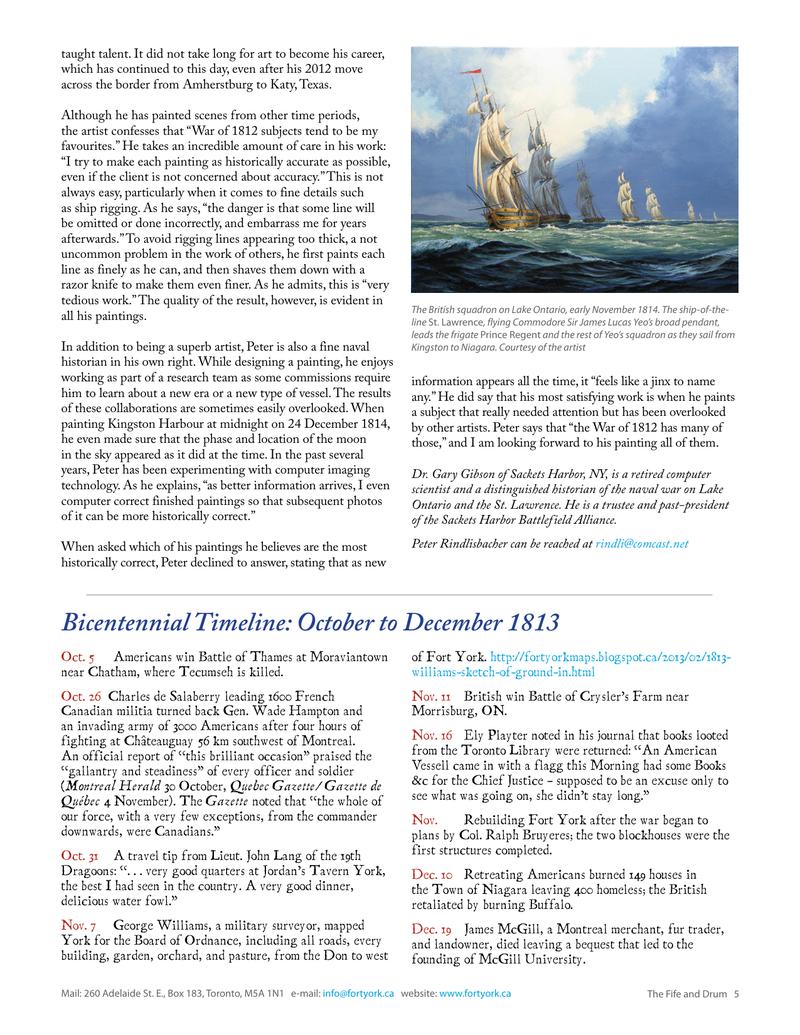
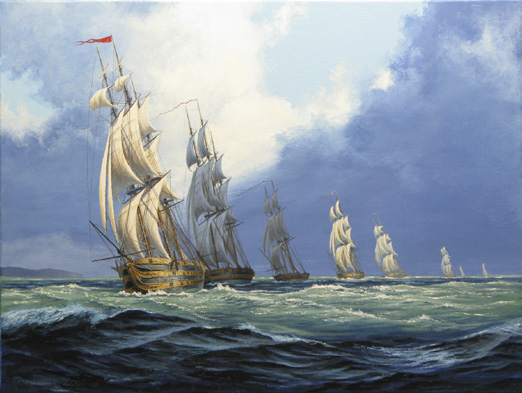
For anyone interested in the naval aspects of the War of 1812 on the lakes, the work of Canadian artist Peter Rindlisbacher is hard to miss. For over twenty-five years he has been producing images that are stunning in their quality and composition while always maintaining a very high level of accuracy both historically and technically.
Rindlisbacher paintings have been featured on the covers of many recent studies of the War of 1812, including those of historians Donald Graves, Robert Malcomson, James Elliott, Barry Gough, and David Skaggs. His paintings have been purchased by governments and organizations on both sides of the border, including the Canadian War Museum, Parks Canada, and the Sackets Harbor Battlefield New York State Historic Site. In addition, the artist has almost fifty posters and prints of his work in circulation, many sponsored by heritage organizations. He has also generously permitted his work to be used to illustrate issues of Fife & Drum.
Considering all that, you might safely assume that he has spent his entire life as a professional artist, but you would be wrong. His formal training was very different: he holds a Ph.D. in clinical psychology from Queen’s University at Kingston. That notwithstanding, Dr. Rindlisbacher was interested in the sea from a very early age.
Born in Windsor, Ontario, Peter built his first boat model at age eight. As he describes it, “I’ve been a boat maniac since youth.” His mother was a commercial artist and his father owned a printing company and was also a part-time boatbuilder, so Peter’s interests came naturally: “early on, I did art when I couldn’t go sailing.” He owned his first boat when he was only twelve and in his teens was a Canadian Yachting Association sailing instructor as well as a racing sailor himself. When it came time for university, however, Peter left the sea and studied for three years in Alberta and a further eight years at Queen’s, earning both a masters and a doctorate in psychology. During those years he never lost his interest in naval art and he began taking commissions for paintings from the increasing number of people who recognized his self-taught talent. It did not take long for art to become his career, which has continued to this day, even after his 2012 move across the border from Amherstburg to Katy, Texas.
Although he has painted scenes from other time periods, the artist confesses that “War of 1812 subjects tend to be my favourites.” He takes an incredible amount of care in his work: “I try to make each painting as historically accurate as possible, even if the client is not concerned about accuracy.” This is not always easy, particularly when it comes to fine details such as ship rigging. As he says, “the danger is that some line will be omitted or done incorrectly, and embarrass me for years afterwards.” To avoid rigging lines appearing too thick, a not uncommon problem in the work of others, he first paints each line as finely as he can, and then shaves them down with a razor knife to make them even finer. As he admits, this is “very tedious work.” The quality of the result, however, is evident in all his paintings.
In addition to being a superb artist, Peter is also a fine naval historian in his own right. While designing a painting, he enjoys working as part of a research team as some commissions require him to learn about a new era or a new type of vessel. The results of these collaborations are sometimes easily overlooked. When painting Kingston Harbour at midnight on 24 December 1814, he even made sure that the phase and location of the moon in the sky appeared as it did at the time. In the past several years, Peter has been experimenting with computer imaging technology. As he explains, “as better information arrives, I even computer correct finished paintings so that subsequent photos of it can be more historically correct.”
When asked which of his paintings he believes are the most historically correct, Peter declined to answer, stating that as new information appears all the time, it “feels like a jinx to name any.” He did say that his most satisfying work is when he paints a subject that really needed attention but has been overlooked by other artists. Peter says that “the War of 1812 has many of those,” and I am looking forward to his painting all of them.
Original printed pages