

When foundations for a new condominium at Bathurst and Fleet Streets were excavated in the Spring of 2006, some well preserved parts of a western addition to the head of the Queen’s Wharf were uncovered. (see Fife & Drum, June 2006) Although extensive reports appeared in the media on the 1850s cribbing that survived in the wet conditions there, no special notice was taken of what has since been recognized as a significant find among the few artifacts recovered from the mud and fill beside the wharf. It was a nine-foot iron rail, slightly damaged along its upper edges but well preserved otherwise. Identified as a full-length ’63 lb. U-rail’ (because a three-foot length weighs 63 pounds and is shaped like an inverted “U”), it is an example of the earliest type of rail used in building the Grand Trunk Railway (GTR) during the 1850s.
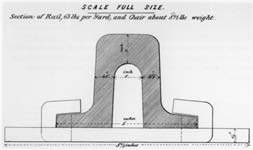
At that time such rails were common, manufactured in huge numbers for the railways that linked the towns and cities of Southern Ontario. For instance, it is estimated conservatively that over 200,000 rails were needed to construct the Toronto-Sarnia section of the GTR. But the design of these rails, British in its origins, did not hold up well in the Canadian winter; water freezing in the “U” caused breakages. Also, the soft iron, which changed shape during normal use, needed to be re-rolled periodically. In 1857 Gzowski & Company, the contractors who built the GTR west of Toronto, established the Toronto Rolling Mills to refurbish old rails and make new ones for the railway. They operated on Mill Street east of Cherry in the city’s east end until 1869, when steel rails were introduced.

During the 1870s most old iron rails were replaced by steel ones. But our Queen’s Wharf find escaped the fate of countless others that got melted down in the furnaces of old Toronto. Instead, it was discarded into the harbour, an expedient but somewhat ignominious end. Today it is now the only whole example of its type known to survive. The rail may have been laid on the wharf when that structure was lengthened in the 1850s and remained there long after others of its type were replaced, because traffic on the wharf was light, consisting of only a few engines, tenders and freight cars.
A combination of the rail’s unusual grave and fortuitous recovery almost 150 years later provides us with a rare reminder of the earliest railways in the province, the development of the City’s waterfront and the famous Queen’s Wharf itself. The rail and some of the massive wooden cribbing from the wharf, both now on permanent display at Fort York, were recovered from the condominium excavations with the cooperation of Malibu Investments Inc.
Original printed pages


