

Fort York is able to defend itself once more from the western approach now that artifact 18 and 24-pounder guns have been remounted on garrison carriages and traversing platforms. The site experience was more vivid this season as visitors were greeted by the “business end” of our large harbour defence guns poking ominously over the western wall. Few objects have such a startling impact for site guests who joke about being “aimed upon” as they make their way into the Fort. The guns, along with the fraises (horizontal palisades) in the dry moats, set the initial tone for visitors and reinforce the Fort’s role as Toronto’s primary harbour defence for much of the 19th century.
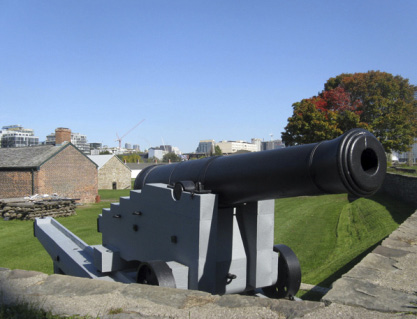
What makes this latest reinstallation unique, however, is that the new carriages and platforms are fabricated from cast aluminum, complete with visible wood grain and imperfections intended to mimic original artillery support systems. Painted the British Army’s “common colour” or ordnance grey, the system requires visitors to actually tap on the structure in order to confirm the metal construction. The new aluminum carriages, produced by MST Bronze of Toronto working closely with Sandra Lougheed, outdoor public art conservator, solve the costly, decades-old fight with the elements to maintain traditionally-built wooden platforms and carriages. Beyond the routine costs of painting and repair, the sourcing of appropriate species of wood with the right grain structure in the right dimensions has proven near impossible in recent years and various experiments with laminated hard woods were unsuccessful.

In fact, the new carriages solve an environmental problem that military planners in the 19th century battled constantly – the weather. Historically, large calibre guns were often removed from their wooden carriages during periods of relative peace and stored under the protective roof of a gun shed to ensure their longevity. The artillery barrels or tubes were usually left in their defensive positions supported by weather resistant cast iron carriages. Though functional as a basic support, iron carriages were not as robust as their wooden counterparts and never intended to support a gun in action. Reproduction versions of these so-called “peacetime” carriages can be seen today at the Fort in the Circular Battery and in the North Bastion.
This capital project was time-consuming and costly, but like the reconstructed wellhead, it is an important feature to put back in the cultural landscape.
Original printed pages


